Monday, June 6, 2011

It's Gelfand vs Anand for world title: Israel Vs India:
Candidates final on Wednesday at Kazan, will be between Boris Gelfand of Israel and Viswanathan Anand (who is one year younger than Boris).
Interestingly, Anand has met only players younger to him since he faced Anatoly Karpov (1998) and Garry Kasparov (1995) for the world title. Alexei Shirov, Vladimir Kramnik and Veselin Topalov, who met Anand in 2000, 2008 and 2010 respectively, are all younger to him.
Gelfand showed tremendous fighting qualities to prevail over the young Russian,Alexander Grischuk, who had his chances in the first five games but co
uld not convert them into wins. Gelfand's masterstroke came in the sixth game on Wednesday when he won in 35 moves in Grunfeld Defence.
Curiously, Gelfand had a good record against Anand in tournament play in the 1990s but the Israeli, who was born in Belarus, could not make any headway in the world championship.
However, in the last three years he has been in terrific form, climbing up in world ranking. IT SEEMS THAT THE CANDIDATES FINAL WOULD BE VERY INTERESTING.
CHESS PUZZLE: FOR INTERMEDIATE PLAYERS:
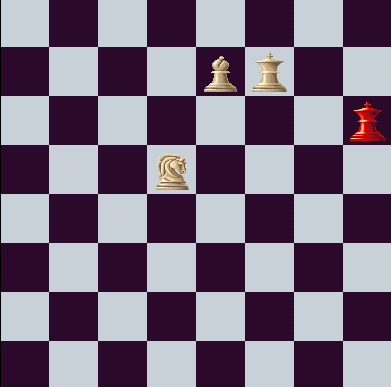
Q. White to play and win in
5 moves. Please try to solve the Puzzle without looking at the solution. The beauty of this end-game is the positioning of Knight--King combination. Please try to solve the Puzzle without looking at the solution.
Sol:
1 Nf4 Kh7
2 Bg5 Kh8
3 Ng6+ Kh7
4 Nf8+ Kh8
5 Bf6++ Mate
Thanks!!
Thursday, April 23, 2009
AICF may reconsider ban on GM Gopal
CHENNAI: The All India Chess Federation (AICF) has expressed its willingness to reconsider its ban on Grandmaster GN Gopal.
Talking to TOI on Wednesday, AICF secretary DV Sundar said the federation would look into the matter again if the player appealed against the ban.
"We have kept the options open and we have told the player that he can appeal against the decision," said Sundar.
GN Gopal was banned by AICF afer the Kerala-based GM took part in a tournament in Canada skipping the National A in Mangalore late last year.
The chess fraternity, including the Chess Players Association of India, had reacted sharply against the decision. AICF came under pressure because World champion Viswanathan Anand and some former national champions also supported Gopal.
Sundar said the federation would organise a series of GM tournaments in India to give more opportunities to the players. The first of it will be an open tournament with 26 GMs in Mumbai from April 30 to May 10.
Talking to TOI on Wednesday, AICF secretary DV Sundar said the federation would look into the matter again if the player appealed against the ban.

"We have kept the options open and we have told the player that he can appeal against the decision," said Sundar.
GN Gopal was banned by AICF afer the Kerala-based GM took part in a tournament in Canada skipping the National A in Mangalore late last year.
The chess fraternity, including the Chess Players Association of India, had reacted sharply against the decision. AICF came under pressure because World champion Viswanathan Anand and some former national champions also supported Gopal.
Sundar said the federation would organise a series of GM tournaments in India to give more opportunities to the players. The first of it will be an open tournament with 26 GMs in Mumbai from April 30 to May 10.
Saturday, March 14, 2009
Anand finishes fourth as Grischuk wins Linares tourney
LINARES (Spain): World champion Viswanathan Anand had to content with a fourth place finish following his final round draw against Magnus Carlsen of Norway in the Magistral Ciudad De Linares chess tournament on Sunday. 
Grandmaster Alexander Grischuk of Russia won the tournament after settling for a draw with Levon Aronian of Armenia. Grischuk finished with eight points in all and tied for the top spot along with Vassily Ivanchuk of Ukraine.
The tiebreak favoured Grischuk as he had won three games in the event compared to two victories by Ivanchuk who drew with Lenier Dominguez of Cuba in his final round game. The tiebreak favoured player with more decisive games and despite remaining unbeaten, Ivanchuk finished second.
Carlsen finished third on 7.5 points, a half point ahead of Anand who in turn had half a point more than Aronian, Wang Yue Of China and Teimour Radjabov of Azerbaijan. Dominiguez finished last on 6 points.
The final day did not have even a single decisive game and the standings remained same as they were after the penultimate round.
Grischuk gained a great deal from his performance here as apart from the trophy and winner's cheque, the Russian also earned right to take part in the Grand Slam final scheduled to be held in Bilbao, Spain later this year.
This was by far the best performance ever by Grischuk who was the semifinalist in the world championship of 2000 when it was held at New Delhi.
For Anand the final day did not have much excitement as Carlsen played solid and safe with his black pieces. Anand came back to the queen pawn and faced the Grunfeld defense, got just an optical advanatage out of the opening and when Carlsen regrouped his forces well, the draw was agreed after 29 moves.
Grischuk had to defend well with black against Aronian and he did precisely that. It was a King's Indian defense where the Armenian got a whiff of an advantage but Grischuk neutralised in quick time. A series of exchanges led to a balanced position with queens, rook and a minor piece onboard but it was quite difficult for Aronian to make progress. The game lasted 41 moves.
Ivanchuk did not get any chance either against Dominguez who played the white side of a closed Ruy Lopez. Equalising early, Ivanchuk was never in any troubles and exchanged pieces at will to get a level rook and minor piece end game where the draw was a just result.
The other match of the final round saw Wang Yue settling for a draw with Radjabov.

Grandmaster Alexander Grischuk of Russia won the tournament after settling for a draw with Levon Aronian of Armenia. Grischuk finished with eight points in all and tied for the top spot along with Vassily Ivanchuk of Ukraine.
The tiebreak favoured Grischuk as he had won three games in the event compared to two victories by Ivanchuk who drew with Lenier Dominguez of Cuba in his final round game. The tiebreak favoured player with more decisive games and despite remaining unbeaten, Ivanchuk finished second.
Carlsen finished third on 7.5 points, a half point ahead of Anand who in turn had half a point more than Aronian, Wang Yue Of China and Teimour Radjabov of Azerbaijan. Dominiguez finished last on 6 points.
The final day did not have even a single decisive game and the standings remained same as they were after the penultimate round.
Grischuk gained a great deal from his performance here as apart from the trophy and winner's cheque, the Russian also earned right to take part in the Grand Slam final scheduled to be held in Bilbao, Spain later this year.
This was by far the best performance ever by Grischuk who was the semifinalist in the world championship of 2000 when it was held at New Delhi.
For Anand the final day did not have much excitement as Carlsen played solid and safe with his black pieces. Anand came back to the queen pawn and faced the Grunfeld defense, got just an optical advanatage out of the opening and when Carlsen regrouped his forces well, the draw was agreed after 29 moves.
Grischuk had to defend well with black against Aronian and he did precisely that. It was a King's Indian defense where the Armenian got a whiff of an advantage but Grischuk neutralised in quick time. A series of exchanges led to a balanced position with queens, rook and a minor piece onboard but it was quite difficult for Aronian to make progress. The game lasted 41 moves.
Ivanchuk did not get any chance either against Dominguez who played the white side of a closed Ruy Lopez. Equalising early, Ivanchuk was never in any troubles and exchanged pieces at will to get a level rook and minor piece end game where the draw was a just result.
The other match of the final round saw Wang Yue settling for a draw with Radjabov.
Wednesday, January 28, 2009
Abhijeet wins, Sasikiran loses again
WIJK AAN ZEE (The Netherlands): World Junior champion Abhijeet Gupta came back reckoning for top honours with a fine positional triumph over veteran Grandmaster Oleg  Romanishin of Ukraine in the 9th round of the 'C' group of Corus International chess tournament.
But Grandmaster Krishnan Sasikiran suffered a defeat at the hands of David Navara of Czech Republic in the 'B' group to make it a mixed day for the Indian contingent.
Abhijeet took his tally to a respectable 5.5 points out of a possible nine and is now in joint third position along side Frank Holzke of Germany and David Howell of England.
The lead position remained unchanged after Tiger Hillarp Persson of Sweden played out a draw with D Harika and inched himself up to 6.5 points. The second place is held by Wesley So of Philippines who made short work of local hopeful Ali Bitalzadeh.
In the 'B' group Sasikiran will look forward to saving some of the vital elo points.
The Indian has 3 points and is playing much below his expected score. Abhijeet played his moves well to beat the experienced Romanishin. Expectedly the Ukrainian employed the Nimzo Indian and faced the Capablanca variation.
Abhijeet got a bind in the center and slowly his pieces gained in strength.
Romanishin opted to go for an inferior endgame to cut down on some pressure but ended up losing a pawn for effectively no compensation.
 Romanishin of Ukraine in the 9th round of the 'C' group of Corus International chess tournament.
But Grandmaster Krishnan Sasikiran suffered a defeat at the hands of David Navara of Czech Republic in the 'B' group to make it a mixed day for the Indian contingent.
Abhijeet took his tally to a respectable 5.5 points out of a possible nine and is now in joint third position along side Frank Holzke of Germany and David Howell of England.
The lead position remained unchanged after Tiger Hillarp Persson of Sweden played out a draw with D Harika and inched himself up to 6.5 points. The second place is held by Wesley So of Philippines who made short work of local hopeful Ali Bitalzadeh.
In the 'B' group Sasikiran will look forward to saving some of the vital elo points.
The Indian has 3 points and is playing much below his expected score. Abhijeet played his moves well to beat the experienced Romanishin. Expectedly the Ukrainian employed the Nimzo Indian and faced the Capablanca variation.
Abhijeet got a bind in the center and slowly his pieces gained in strength.
Romanishin opted to go for an inferior endgame to cut down on some pressure but ended up losing a pawn for effectively no compensation.
Sunday, January 25, 2009
Sasi held by Motylev at Corus chess
WIJK AAN ZEE (The Netherlands): Grandmaster Krishnan Sasikiran played out a draw with Alexander Motylev in the eighth round of the 'B" group of Corus chess tournament.
Sasikiran took his tally to 3 points with the draw and it seems that the fortunes of the top seed Indian in the fray are just not changing.
Ahead of the second rest day Sasikiran again could not get much to hope for with his white pieces as Motylev kept himself in contention in a Queen pawn game and after the dust subsided the players just had a level position on board. The peace was signed in 32 moves.
It turned out to be a bad day for Grandmaster Abhijeet Gupta too in the 'C' group as he went down to Grandmaster Friso Nijboer of Holland.
The loss dented Abhijeet's chances in the event considerably after Tiger Hillarp Person of Sweden managed to eek out a win against Mexican Manuel Leon Hoyos.
Persson emerged as the sole leader in this section on 6 points out of a possible eight and stretched his lead to a full point after top seed Wesley So of Philippines blundered and lost to Frank Holzke of Germany.
Wesley remained on 5 points and in sole second spot despite the disaster and Abhijeet now shares the third spot with David Howell of England and local hopeful Manuel Bosboom who played out a draw with D Harika in this round.
Playing the black side of a Ruy Lopez Abhijeet was surprised early in the opening after sacrificing a pawn and did not get a chance to recover during the remaining part of the game.
The Indian was forced to spend a lot of time in the early middle game and Nijboer increased his advantage after a couple of more inaccuracies by the Indian world junior champion.
Sasikiran took his tally to 3 points with the draw and it seems that the fortunes of the top seed Indian in the fray are just not changing.

Ahead of the second rest day Sasikiran again could not get much to hope for with his white pieces as Motylev kept himself in contention in a Queen pawn game and after the dust subsided the players just had a level position on board. The peace was signed in 32 moves.
It turned out to be a bad day for Grandmaster Abhijeet Gupta too in the 'C' group as he went down to Grandmaster Friso Nijboer of Holland.
The loss dented Abhijeet's chances in the event considerably after Tiger Hillarp Person of Sweden managed to eek out a win against Mexican Manuel Leon Hoyos.
Persson emerged as the sole leader in this section on 6 points out of a possible eight and stretched his lead to a full point after top seed Wesley So of Philippines blundered and lost to Frank Holzke of Germany.
Wesley remained on 5 points and in sole second spot despite the disaster and Abhijeet now shares the third spot with David Howell of England and local hopeful Manuel Bosboom who played out a draw with D Harika in this round.
Playing the black side of a Ruy Lopez Abhijeet was surprised early in the opening after sacrificing a pawn and did not get a chance to recover during the remaining part of the game.
The Indian was forced to spend a lot of time in the early middle game and Nijboer increased his advantage after a couple of more inaccuracies by the Indian world junior champion.
Sunday, November 2, 2008
An interview with World Chess Champion Anand of India
Grandmaster Viswanathan Anand of India just defeated Grandmaster Vladimir Kramnik of Russia in a 12-game World Championship match in Bonn, Germany to retain his title. The final score was 6.5 - 4.5. The match prize funds are 1.5 million Euros ($2.35 million U.S.).
Here is the continuation of my column last week.
Susan Polgar: What role do computers play in today's chess?
Viswanathan Anand: Well, I think it is like having the best tactical player in the world at your disposal 24/7.
Clearly, you have to find a way to use that. And of course as the processors get better, the computer goes a little bit further out. So nowadays, we have engines even suggesting non-tactical moves, simply because they look so far ahead. And I think it is a great help.
But of course you have to make sure that you don't drown in that information, so you have to keep track of what you do. Essentially, it comes down to the same thing, getting to the heart of the position, some key concepts, and then being able to get to the bottom of things.
SP: How have you been able to maintain your top level for two decades?
Anand: I think it is basically easy, because chess is fascinating and it is very easy to keep that. And of course when I start to lose it, I take off for a few months and maybe take a vacation and do something else and things usually come back after that.
Sometimes you manage to stop on your own, and sometimes it takes a heavy defeat to stop you. But anyway, usually after you stop for a while, you'll get it back, as long as you maintain this kind of balance with the right amount of chess. You need practice and you need to maintain that tournament tension to have that feeling. If you stay away for too long, you lose that and then it is harder to come back.
But if you can sort of manage this kind of balance, it's nice. I like to lose myself in my hobbies as well, like astronomy and traveling. And this is nice because it allows you to put chess in the proper place.
SP: How many countries have you visited and do you have a favorite?
VA: Actually, I just reached forty-nine. So I am hoping to get to fifty.
SP: Can you tell me about the chess in the school's program in India?
VA: We currently have a program called Mind Champion's Academy. It is an idea from the IT company that I work with (NIIT), they already do all the computer education through many schools in many states, so something like 4,000-plus schools, with a total student population of more than 1.4 million. And of that, more than 70,000 have played in a competition this year. The nice thing is that we also reach out to non-traditional areas; not only the cities, but small towns and villages as well. So hopefully in five to ten years, we will start to see the effect of this as more and more people enter the chess world.
But the idea for the students is that even if their attraction for chess is limited, we think it is a good tool to help their academics, to develop certain skills and so on. So it is a win-win situation and that's what I'm excited about. Obviously when I come back now, it is a program that I'll continue.
SP: What role does chess play in education?
VA: I think nowadays, children need all the help they can get and generally children learn better in the form of a game. So in that sense, chess has a role because it teaches them problem solving, but in a fun way, because they will reject anything that bores them.
For chess, I think there is an incentive because it will help the sport. But frankly, it is a big help for the schools and it gives the kids something to do. Perhaps it will replace other less healthy alternatives. To give them anything that's fun and positive is good.
I think that's one area where chess will grow, because many countries are doing the same thing, and all based on the theory that chess develops skills that are useful. I think it's something that will prosper.
SUSAN POLGAR is a professional chess player, champion and founder of the Susan Polgar Institute for Chess Excellence at Texas Tech, susan.polgar@ttu.edu.
Here is the continuation of my column last week.
Susan Polgar: What role do computers play in today's chess?

Viswanathan Anand: Well, I think it is like having the best tactical player in the world at your disposal 24/7.
Clearly, you have to find a way to use that. And of course as the processors get better, the computer goes a little bit further out. So nowadays, we have engines even suggesting non-tactical moves, simply because they look so far ahead. And I think it is a great help.
But of course you have to make sure that you don't drown in that information, so you have to keep track of what you do. Essentially, it comes down to the same thing, getting to the heart of the position, some key concepts, and then being able to get to the bottom of things.
SP: How have you been able to maintain your top level for two decades?
Anand: I think it is basically easy, because chess is fascinating and it is very easy to keep that. And of course when I start to lose it, I take off for a few months and maybe take a vacation and do something else and things usually come back after that.
Sometimes you manage to stop on your own, and sometimes it takes a heavy defeat to stop you. But anyway, usually after you stop for a while, you'll get it back, as long as you maintain this kind of balance with the right amount of chess. You need practice and you need to maintain that tournament tension to have that feeling. If you stay away for too long, you lose that and then it is harder to come back.
But if you can sort of manage this kind of balance, it's nice. I like to lose myself in my hobbies as well, like astronomy and traveling. And this is nice because it allows you to put chess in the proper place.
SP: How many countries have you visited and do you have a favorite?
VA: Actually, I just reached forty-nine. So I am hoping to get to fifty.
SP: Can you tell me about the chess in the school's program in India?
VA: We currently have a program called Mind Champion's Academy. It is an idea from the IT company that I work with (NIIT), they already do all the computer education through many schools in many states, so something like 4,000-plus schools, with a total student population of more than 1.4 million. And of that, more than 70,000 have played in a competition this year. The nice thing is that we also reach out to non-traditional areas; not only the cities, but small towns and villages as well. So hopefully in five to ten years, we will start to see the effect of this as more

 and more people enter the chess world.
But the idea for the students is that even if their attraction for chess is limited, we think it is a good tool to help their academics, to develop certain skills and so on. So it is a win-win situation and that's what I'm excited about. Obviously when I come back now, it is a program that I'll continue.
SP: What role does chess play in education?
VA: I think nowadays, children need all the help they can get and generally children learn better in the form of a game. So in that sense, chess has a role because it teaches them problem solving, but in a fun way, because they will reject anything that bores them.
For chess, I think there is an incentive because it will help the sport. But frankly, it is a big help for the schools and it gives the kids something to do. Perhaps it will replace other less healthy alternatives. To give them anything that's fun and positive is good.
I think that's one area where chess will grow, because many countries are doing the same thing, and all based on the theory that chess develops skills that are useful. I think it's something that will prosper.
SUSAN POLGAR is a professional chess player, champion and founder of the Susan Polgar Institute for Chess Excellence at Texas Tech, susan.polgar@ttu.edu.
Subscribe to:
Posts (Atom)